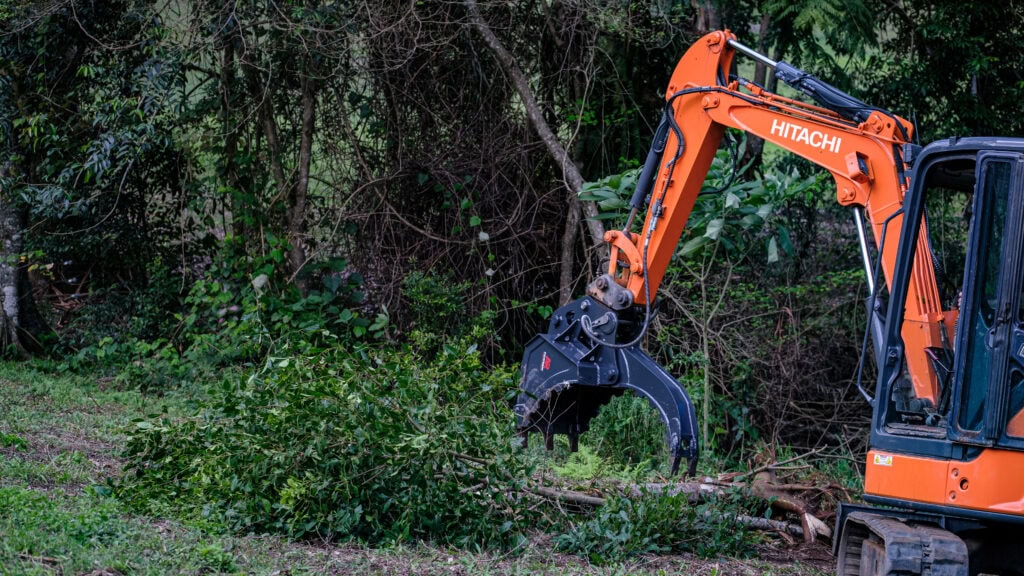
- Fixed grabs for logs and rock; rotating grabs for demolition sorting and timber.
- Buy in your excavator’s tonne band. A grab from the band above eats lift capacity at reach.
- Quick hitches must meet AS 13031:2023 (formerly AS 4772). Safety pin in, every change.
- Expect roughly $2,000 for a small fixed grab up to $30,000 plus for a large rotating demolition grab.
How to Choose Excavator Grab Attachments for Your Machine
Excavator grab attachments turn a digging machine into one that can pick up, sort, carry and place. Logs, rock, demolition rubble, scrap, root balls, old fence posts: anything a bucket can only push around, a grab lifts cleanly and puts it exactly where you want it. Which grab you buy comes down to four things. What you are picking up, what your excavator weighs, what hydraulics it has at the end of the stick, and how the attachment is hitched.
Get those four right and a grab attachment for excavator work pays for itself fast, especially on demolition and clearing jobs. Get one wrong, and you own a $10,000 attachment that starves for oil or is too heavy to swing safely at reach. Here is how we work through it with customers on the phone.
What types of excavator grab attachments are there?
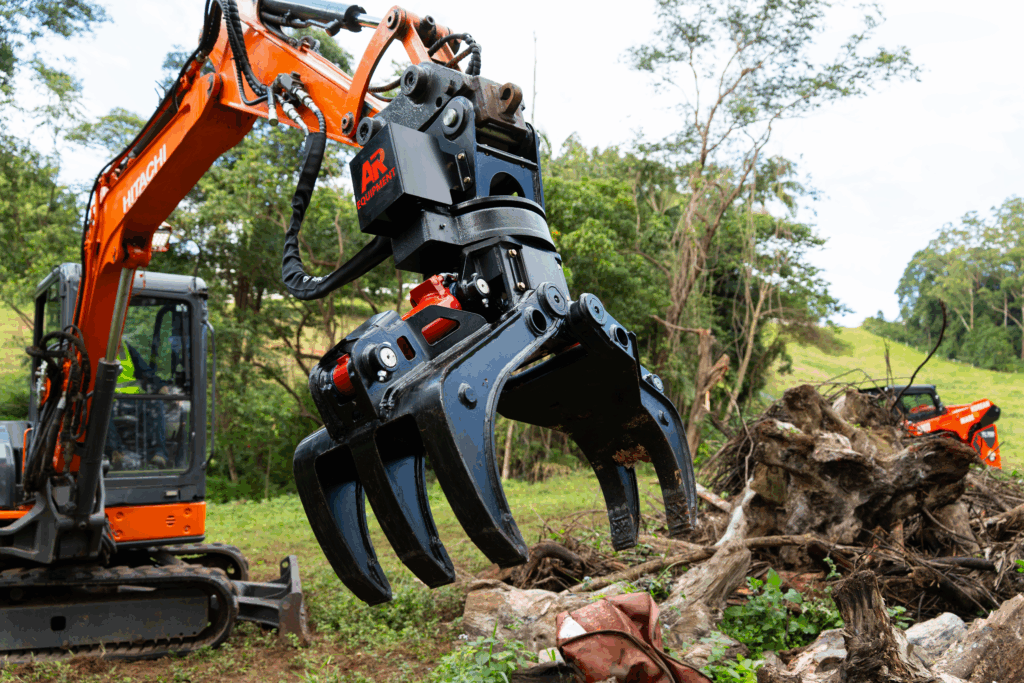
Grabs sort into fixed or rotating, hydraulic or mechanical, and then by the job they are built for. Start with the first two splits.
Fixed or rotating?
A fixed grab opens and closes, and that is all. You line the load up by slewing and curling the stick. It is lighter, cheaper and runs two hoses instead of four. For an owner-operator picking up logs or rock on a 3 to 8 tonne machine, fixed is usually the sensible buy.
A rotating grab adds a hydraulic rotator between the hitch and jaws, normally 360-degree continuous. You can turn a log to lie along the trailer, or spin a slab so it drops flat into the bin, without moving the tracks. On a demolition site where you sort timber from steel from masonry all day, that saves hours. The trade-off is more weight, a second hydraulic circuit or a diverter valve, and a rotator to service.
Hydraulic or mechanical?
A hydraulic grab closes with its own cylinder, or two in a twin ram design, and needs an auxiliary circuit at the stick. Nearly every grab sold today is hydraulic because you can hold a load closed while you curl, slew and travel.
A mechanical log grab has no cylinder. One jaw is fixed, and the other is driven by the bucket ram, so closing the grab and curling the wrist are the same movement. It suits older excavators with no auxiliary hydraulics, and AR Equipment still stocks mechanical log grabs for them, but most buyers will miss the independent wrist control.
Job-specific grab designs
Demolition and sorting grabs have wide shell or multi-tine jaws, almost always rotating, for picking masonry, timber and steel out of a mixed pile. Log and timber grabs use narrow curved tines that close around a round load. Rock grabs run shorter, thicker tines with reinforced tips, because a rock slips where a log will not. Multi-tine land clearing grabs (four or five open fingers) let soil fall through while holding a root ball or a bundle of lantana. And a grab bucket is a digging bucket with a hydraulic thumb, a fair compromise on 1.7 to 9 tonne machines that change jobs all day.
Which grab suits your excavator’s weight class?
Match the grab to your excavator’s operating weight, not to the biggest load you hope to lift. Excavator grab attachments are sized in tonne bands, roughly 1 to 3, 3 to 6, 7 to 9, 12 to 15, 20 to 23, 25 to 30 and 35 plus. Pick the band your machine sits in. Going one band up rarely helps.
A grab is dead weight on the end of the stick. On AR Equipment’s hydraulic log and rock grab range, the 1 to 2.9 tonne model weighs 75 kg with a 515 mm jaw opening. The 20 to 23 tonne model weighs 1,250 kg and opens to 1,465 mm. Hang a 310 kg grab built for a 7 to 9 tonne machine off a 5-tonner, and you have spent a big slice of your lift capacity at reach before the first log. A 1.7-tonne mini wants the 75 kg grab, with soft jaws as an option for pavers and sandstone. At 30 tonnes, the grab itself weighs over a tonne, and the conversation shifts to hitch rating and rotator flow.
Hydraulic flow, auxiliary circuits and hitch compatibility
Does your excavator have the right auxiliary circuit?
A hydraulic grab needs a double-acting auxiliary circuit at the end of the stick: two hoses, oil pushed one way to close and the other to open. Most excavators over 3 tonnes built in the last decade have one for a breaker or auger. Check the couplers at the stick end, then check the flow figure in your manual against the grab’s rating.
Pressure is rarely the sticking point. AR Equipment’s grab cylinders are rated to 350 bar (5,000 psi), above what most excavator auxiliary circuits deliver. Flow is what to watch. Too little and the jaws crawl. Too much through a rotator motor and you will cook the seals. Rotating grabs want a second, lower-flow circuit for the rotator, or a diverter valve so one circuit does both jobs from a switch in the cab.
Pin-on, quick hitch or tilt hitch?
Pin-on is cheapest and strongest: the grab mounts straight onto the stick pins and stays there. A quick hitch lets you swap between grab, bucket and breaker from the seat. To fit one, the supplier needs your pin diameter, pin centres and dipper width, so measure all three before you call. AR Equipment lists double pin hitches at roughly $550 to $725. Tilt hitches add side tilt under a fixed grab, handy on rock walls and batters, but hitch, tilt module and grab together can push a 5 tonne machine past what its front end was built to carry at full reach.
Whatever hitch you run, it needs to meet the Australian standard. AS 4772-2008 is still the number most people quote, but it was replaced on 5 May 2023 by AS 13031:2023 (Earthmoving machinery, Quick couplers, Safety), Australia’s adoption of ISO 13031. Both call for a primary retention system plus an independent safety device, and on manual and semi-automatic hitches, that safety pin goes in every time you change attachments. Safe Work Australia’s quick hitch information sheet records a number of Australian fatalities from attachments dropping off hitches without warning. A grab holding a tonne of concrete in the air is not the attachment to run with the pin left on the dash.
What jobs are grab attachments used for?
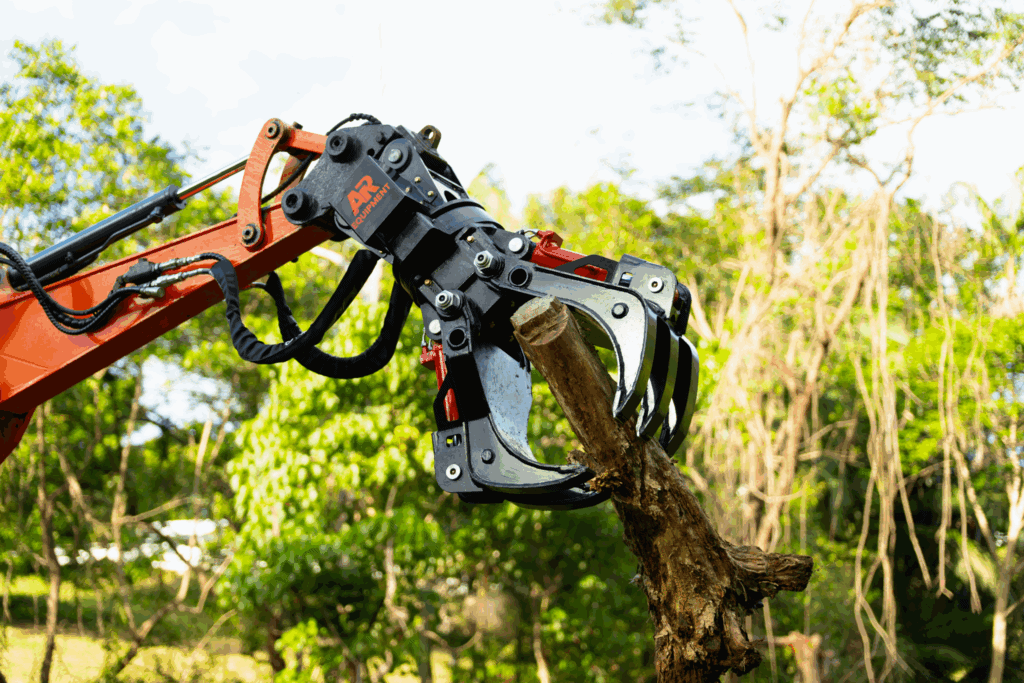
Demolition sorting is the big one: timber, steel and masonry into separate bins on site, which cuts tip fees enough that the grab often pays for itself on a single house strip-out. Land clearing is next, pulling scrub, stacking windrows and lifting stumps without half a tonne of soil attached. Then rock walls, where a bucket cannot control how a boulder lands, and firewood work, loading trucks and feeding a splitter. Scrap and recycling is where AR Equipment started, building grabs for its own recycling and demolition fleet.
How do you look after a grab attachment?
Four habits cover most of it.
- Grease every pivot pin daily when the grab is in use. Dry pins wear oval, and oval bores stop the tines meeting squarely.
- Check hoses each shift, especially past a rotator, and watch for a cylinder weeping at the rod seal. A reseal is cheaper than a dropped load.
- Look at the tine tips weekly. Worn tips slip, and hard-facing or replacing a tip costs a fraction of a new tine.
- Stay in your weight class. Most bent tines come from a grab run on a machine a band or two heavier than it was sized for.
AR Equipment’s Sunshine Coast workshop holds spares for the excavator grab attachments it sells, so a reseal or a set of tips does not mean waiting on a container.
What do excavator grab attachments cost in Australia?
A new excavator grab in Australia runs from roughly $2,000 for a small fixed hydraulic grab on a mini to $30,000 plus for a large rotating demolition or timber grab on a 30 tonne machine. Weight class sets the base. Rotation adds several thousand dollars over the fixed equivalent. Twin rams, 350 bar cylinders and replaceable tips push the price up and the wear rate down, and a hitch or soft jaws (around $750 on AR Equipment’s smaller grabs) sit on top. AR Equipment’s listed ranges at the time of writing, ex GST:
- Hydraulic log and rock grabs: 1 to 55 tonne: $2,150 to $35,500
- Grab buckets:1 to 9 tonne: $2,850 to $9,990
- Twin ram hydraulic grabs: 1 to 23 tonne: $6,500 to $17,990
- GEN 2 rotating grabs: 3 to 40 tonne: $9,500 to $24,990
- Mechanical log grabs: $9,990 to $29,990
- Rotating demolition sorting grabs: 5 to 40 tonne: $11,990 to $26,990
Cheaper imports exist, and where they usually fall down is cylinder rating, pin bore tolerance and tine steel, which shows up as slop and cracked welds after a season. Repeat AR Equipment customers also get 5% off for life after their first purchase.
Frequently Asked Questions
Yes, with a diverter valve. It mounts on the stick and switches the single circuit between the jaw cylinder and the rotator from a button in the cab, so you cannot rotate and close at the same instant. The other route is a fixed grab on a tilt hitch. Tell AR Equipment your circuit setup when you call.
There is no single national excavator licence. Most sites and employers ask for a Statement of Attainment in RIIMPO320F (Conduct civil construction excavator operations) plus a Verification of Competency for the specific machine and attachment. Fitting a grab does not add a separate ticket, but your VOC should cover attachment changes and load handling.
AR Equipment holds more than 500 attachments in stock on the Sunshine Coast for immediate dispatch and freights Australia-wide to your nearest depot. A stocked grab in your weight class is usually on a truck within days, against the weeks or months a factory order from overseas can take.
For a second opinion on which grab suits your machine and the work in front of it, Call Us Today and talk to the team at AR Equipment, 21 Whalley Creek Close, Burnside QLD 4560.
About the Author
AR Equipment, Earthmoving attachment specialists, 30+ years across the team
AR Equipment supplies excavators and skid steer attachments to contractors, owner-operators and OEMs across Australia, with more than 30 years of combined experience in earthmoving, demolition and land clearing.
References for statistics and claims cited in this article.
- Standards Australia, AS 13031:2023 Earthmoving machinery, Quick couplers, Safety (ISO 13031:2016 MOD), published 5 May 2023, replaces AS 4772-2008: https://store.standards.org.au/product/as-13031-2023
- Safe Work Australia, Quick-hitches for earthmoving machinery information sheet: https://www.safeworkaustralia.gov.au/system/files/documents/1703/quick-hitches-for-earthmoving-machinery-information-sheet.pdf
- AR Equipment, Excavator Hydraulic Log/Rock Grabs product specifications and pricing: https://arequipment.com.au/attachment/excavator-hydraulic-grabs-logs-rocks/
- AR Equipment, Excavator Grabs category (price ranges by product line): https://arequipment.com.au/attachments/excavator/excavator-grabs/
- AR Equipment, About Us (company history, stock levels, repeat customer discount): https://arequipment.com.au/about/