
- A flail mower is a maintenance tool for grass, weeds and light regrowth. A forestry mulcher is a clearing tool for scrub, saplings and small trees.
- Flail mowers use swinging hammer flails that fold back off rock. Forestry mulchers use fixed teeth on a heavy rotor that chews through timber.
- A mulcher needs far more hydraulic flow and pressure than a flail mower, so check your carrier’s auxiliary circuit before you buy.
- Many jobs need both: the mulcher opens up the block, and the flail mower keeps it clean afterwards.
Both heads spin a rotor at high speed and both turn vegetation into mulch, which is why the two get mixed up. They are built for different material, though, and putting the wrong one on your machine either wastes money or wrecks the head.
Here is how a flail mower and a forestry mulcher differ, what each one handles, what your excavator or skid steer needs to run it, and how to pick the right one for the job.
The short answer
Choose a flail mower if you are maintaining ground: slashing grass, keeping roadside batters and drains clean, knocking down lantana and cutting back light regrowth. Choose a forestry mulcher if you are clearing ground: taking out dense scrub, saplings and small trees and leaving a mulch layer behind.
If you are reclaiming an overgrown block and then need to keep it under control, you will likely end up running both.
How a flail mower works
A flail mower has a horizontal rotor fitted with rows of hammer flails that swing freely on their mounts. As the rotor spins, centrifugal force throws the flails out straight and they strike the vegetation, shredding it rather than slicing it like a slasher blade.
Because the flails pivot, they fold back when they hit a rock or a stump and then flick out again. That is what makes a flail mower forgiving on rough, rocky ground, steep banks and roadside work where you cannot see what is in the grass.
Our excavator flail mower uses a helix rotor with swinging hammer flails, a gear motor with cross-line relief and a case drain, and a debris flap door. It comes in 800 mm and 1000 mm cutting widths to suit 3 to 8 tonne excavators, and handles regrowth up to around 80 mm.
How a forestry mulcher works
A forestry mulcher has a heavy drum with teeth fixed solidly to it. Instead of swinging out of the way, the teeth bite into the timber and grind it down. That is what lets a mulcher take on material a flail mower cannot touch.
Our forestry mulcher attachment for excavators runs a bent-axis piston motor and a horsepower-controlled rotor. The rotor limits how deep each tooth bites, so the head keeps spinning in heavy timber instead of stalling. Across the range, maximum shred diameter runs from 250 mm on the 5 to 8 tonne head up to 350 mm on the 20 to 35 tonne head.
The trade-off is that fixed teeth do not forgive rock the way flails do. Hit rock with a mulcher and you will chip and blunt teeth quickly, so it pays to walk the site first.
Flail mower vs forestry mulcher at a glance
| Flail mower | Forestry mulcher | |
|---|---|---|
| Cutting action | Swinging hammer flails | Fixed teeth on a heavy rotor |
| Built for | Grass, weeds, lantana, light regrowth | Dense scrub, saplings, small trees |
| Material size (our range) | Regrowth up to around 80 mm. Can handle timber 50-75mm thick, depending on the species | Up to 250 mm to 350 mm, depending on head size |
| Excavator size (our range) | 3 to 8 tonnes | 5 to 35 tonnes |
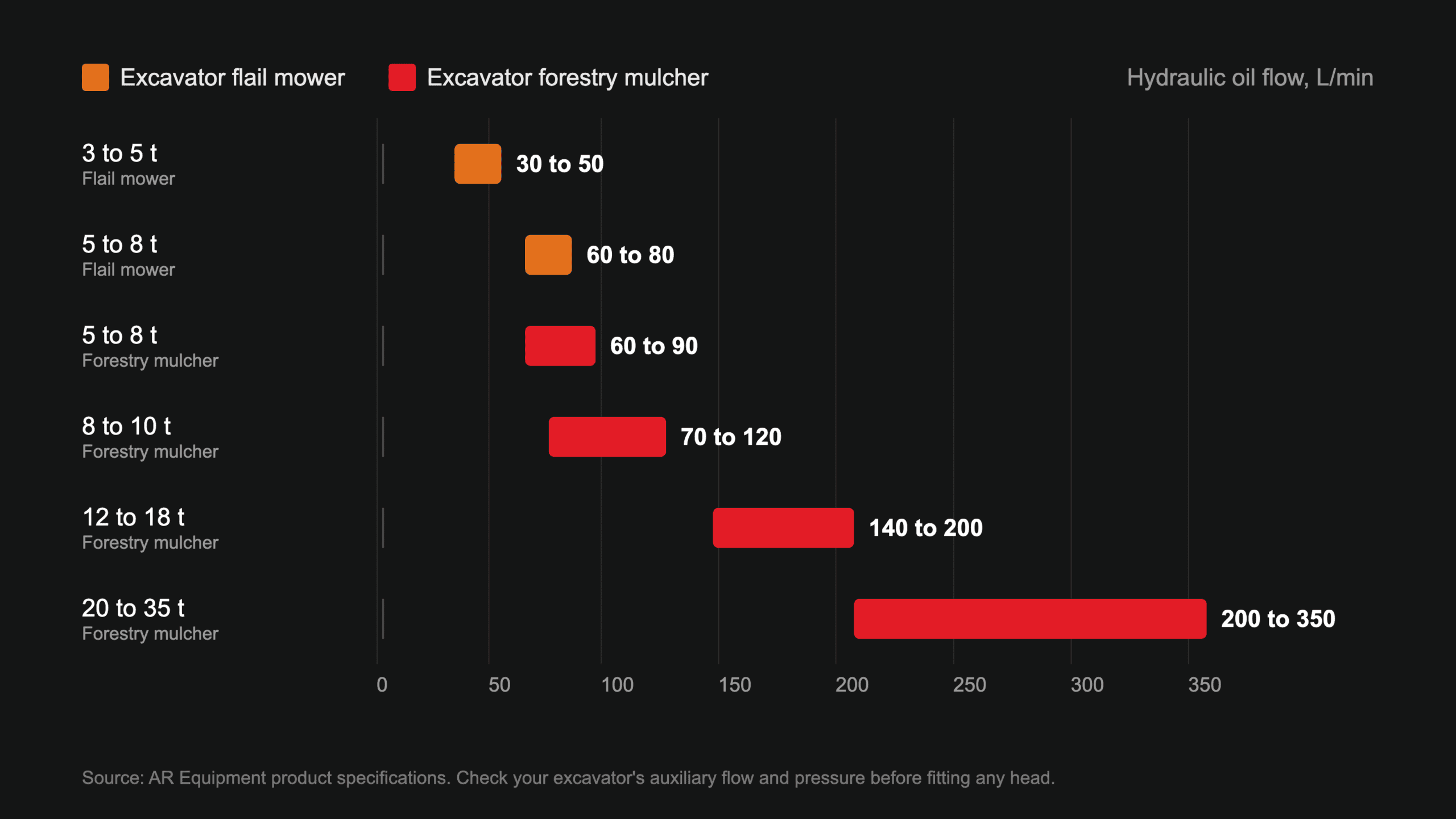
| Oil flow (our range) | 30 to 80 L/min | 60 to 350 L/min |
| Finish | Even, mown finish | Coarser mulch mat over the ground |
| Rocky ground | Flails fold back off rock | Teeth chip and wear on rock |
| Typical role | Ongoing maintenance | Initial clearing |
Match the head to what you are cutting
The material decides the head before anything else does.
Grass, weeds and blackberry. A flail mower. It leaves a tidy, even finish and the flails take the knocks from hidden rocks and rubbish.
Lantana and light regrowth. A flail mower handles lantana and soft regrowth well, which is why it is a favourite for roadside work and drain maintenance. Once the stems get woody and thick, you are into mulcher territory.
Dense scrub, saplings and small trees. A forestry mulcher. Fixed teeth and a heavy rotor are what it takes to bring down woody stems and leave them as mulch on the ground.
Stumps. Neither head removes stumps below ground level. A mulcher will take a stump down to around ground level, but for anything below that you need a stump grinder or to dig it out. A stick rake is the better tool for pushing up and stacking what is left once the timber is down.
Check your hydraulics before you buy
This is where most of the costly mistakes happen. A flail mower and a forestry mulcher both run off your machine’s auxiliary circuit, and they ask very different things of it.
Oil flow. Our excavator flail mowers need 30 to 50 L/min on the 3 to 5 tonne head and 60 to 80 L/min on the 5 to 8 tonne head. Our forestry mulchers need 60 to 90 L/min on the smallest head, 140 to 200 L/min on the 12 to 18 tonne head and 200 to 350 L/min on the 20 to 35 tonne head. Too little flow and the rotor will not reach working speed, which means it tears rather than cuts and bogs down in heavy material.
Pressure. Our forestry mulcher heads run at 240 bar on the 5 to 8 tonne class and up to 350 bar on the larger heads. Check the relief setting on your auxiliary circuit matches the head, not just the flow.
Case drain. Many mulcher and flail mower motors need a case drain line back to tank to protect the motor seals. If your machine does not have a case drain, plan for one before the head arrives.
One-way flow. A rotating head like a mulcher or flail mower generally runs on a one-way (hammer) circuit. If your excavator only has a two-way circuit set up for a tilt bucket or grab, talk to your dealer about the plumbing.
Your operator’s manual or dealer can confirm your machine’s auxiliary flow and pressure. Send us the make and model, and we will tell you straight if a head is not the right fit for your machine.
Excavator or skid steer?
The carrier matters as much as the head.
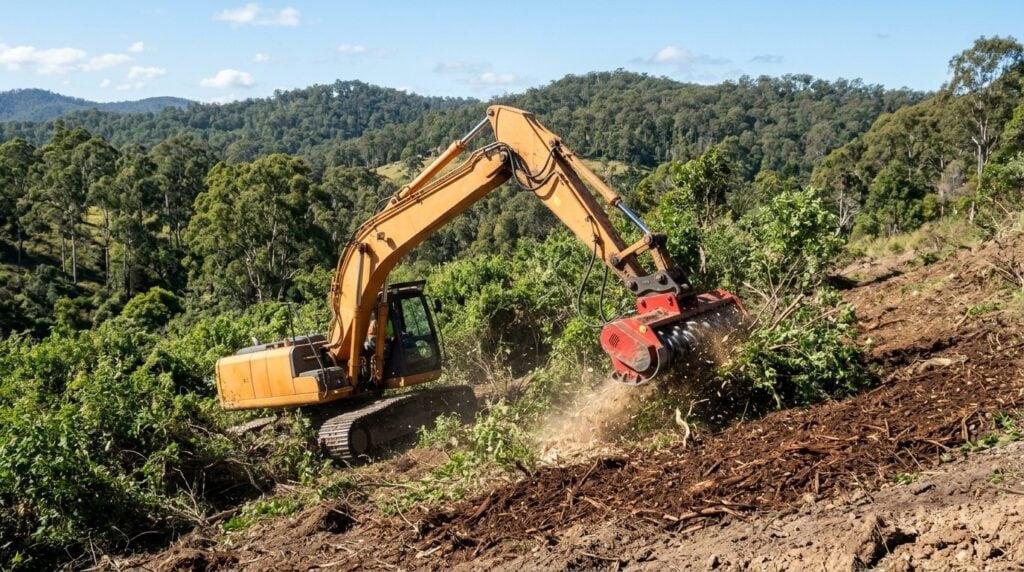
Excavator. Reach and slope are the big advantages. An excavator can sit on a track or bench and reach up batters, down into drains and across creek banks without driving onto soft or steep ground. That is why a flail mower on an excavator is so common for roadside and drainage work, and why an excavator mulcher suits hillside clearing.
Skid steer or compact track loader. On flat, open ground, a skid steer mulcher covers ground quickly because the operator drives straight through the scrub. Our skid steer mulcher comes in standard flow (50 to 80 L/min), variable flow (75 to 120 L/min) and high flow (120 to 190 L/min) versions, so match the model to your loader’s auxiliary output. For grass and light growth on a skid steer, a skid steer slasher is the simpler option.

Running costs and wear parts
A forestry mulcher costs more to buy and more to run. On our current range, the excavator flail mower sits under $10,000 ex GST, while forestry mulcher heads run from $19,990 ex GST for the 5 to 8 tonne class to $54,000 ex GST for the 20 to 35 tonne class. Current pricing is listed on each product page.
Flail mowers. The flails and their bolts are the main wear items. They are cheap to replace and the swinging design spreads the knocks.
Forestry mulchers. Teeth are the main consumable. How quickly you go through them depends almost entirely on how much rock and dirt the head sees. Keep the rotor out of the ground and you will get far more hours from a set.
Both. Grease the rotor bearings, check belts and hoses, and clear packed material from around the rotor at the end of every day. Our slashers, flail mowers and forestry mulchers carry a two-year warranty, with wear parts like teeth excluded. Full details are in our terms and conditions.
Thrown debris and site safety
Both heads throw material, and a forestry mulcher throws wood and stone with real force. The NSW Resources Regulator has published a safety bulletin on a mulching machine that threw a piece of wood through the windscreen of a nearby water cart at the operator’s head height.
Set and keep an exclusion zone around the head in line with the manufacturer’s manual, keep people and vehicles out of it, and stop the rotor when anyone approaches. Keep the debris door or flap in place and in good condition, and check the cab glass and guarding on your carrier is rated for the work.
Check the clearing rules before you start
The head you choose does not change what you are allowed to clear. In Queensland, clearing rules depend on the vegetation category on your property and on local council planning schemes.
The Queensland Government explains that clearing Category X vegetation is exempt on freehold, Indigenous and leasehold land. Other laws can still apply, though, including protected plant permits, koala habitat protections in South East Queensland and local council requirements. Start with a property report and a call to your council. Other states have their own rules, so check locally before the mulcher goes in.
When you need both
On a lot of land clearing and land management jobs, the answer to flail mower vs forestry mulcher is both, at different stages.
The forestry mulcher does the heavy opening up: scrub, saplings and regrowth that has got away. Once the block is clear, regrowth comes back soft and green, and that is flail mower work. Running a flail mower over the regrowth regularly is faster and cheaper than bringing the mulcher back every couple of years.
Contractors who do both kinds of work often run a mulcher on a larger excavator or skid steer and a flail mower on a smaller excavator for maintenance. Our land clearing equipment page covers the full set, and our guide to how land clearing is done walks through the methods.
Not sure which head suits your machine and your job? Call our team on 1300 441 121 or request a quote with your excavator or skid steer make and model.
Frequently asked questions
What is the difference between a flail mower and a forestry mulcher?
A flail mower uses swinging hammer flails to shred grass, weeds and light regrowth, and leaves an even finish. A forestry mulcher uses fixed teeth on a heavy rotor to grind dense scrub, saplings and small trees into mulch. The flail mower maintains ground and the mulcher clears it.
Can a flail mower cut small trees?
Only light ones. Our excavator flail mower handles regrowth up to around 80 mm. Anything thicker or woodier needs a forestry mulcher, which on our range handles material up to 250 mm to 350 mm depending on the head.
Is a flail mulcher the same as a forestry mulcher?
The terms overlap. “Flail mulcher” is often used for a heavy flail head with swinging hammers, while “forestry mulcher” usually means a fixed-tooth rotor built for timber. Check the rotor type and the maximum cutting diameter on the spec sheet rather than relying on the name.
What size excavator do I need for a forestry mulcher?
Our forestry mulchers suit excavators from 5 to 35 tonnes, in four size classes. Hydraulic flow and pressure matter as much as weight, so check your machine’s auxiliary flow against the head before you buy.
Do I need a high-flow skid steer to run a mulcher?
Not necessarily. Our standard-flow skid steer mulcher runs on 50 to 80 L/min. A high-flow loader lets you run a larger head, which clears faster in heavy material.
Can a mulcher remove stumps?
A forestry mulcher takes a stump down to around ground level. Removing it below ground needs a stump grinder or an excavator to dig it out.