From the first site assessment through to the last pass with a stick rake, here’s what a land clearing project actually involves, the methods used, and the kit that does the heavy lifting.
Land clearing sits at the front end of nearly every construction, agricultural, and forestry project in the country. Whether you’re prepping a paddock for cattle, opening up a block for a new build, knocking back forest regrowth that’s crept across a fenceline, or staging a larger development site, the process follows roughly the same pattern. The scale changes. The gear changes. The regulations shift depending on the state. But the underlying process is consistent.
At AR Equipment, we supply the attachments contractors use on land clearing projects from Cape York to the Tassie high country. That puts us in a useful spot to walk through how the work is actually done, what equipment fits which job, and where land clearing projects tend to come unstuck.
What Land Clearing Actually Involves
Land clearing is the removal of vegetation, trees, scrub, stumps, roots, and surface debris from a site so the area can be used for something else. Construction and property development are the common ones, but clearing land is also done for agriculture, fire mitigation, fenceline maintenance, forest thinning, access road creation, and bringing previously unworkable areas of a property into use.
It’s worth being clear on terminology, because people use these interchangeably and shouldn’t:
- Site clearing generally refers to a smaller, defined area being prepped for a specific build.
- Land clearing is broader, covering paddocks, acreage, and larger development sites.
- Vegetation management covers the ongoing work of keeping land in usable condition once it’s been cleared.
Different jobs, different tools, different approvals.
The Land Clearing Process, Step by Step
1. Site Assessment and Planning
Before any vegetation comes down, the site needs a proper look. That covers what’s actually growing on the block, soil type, slope, drainage, access points for machinery, and what’s underground. Buried services, septic systems, and old footings are easy to forget about until a ripper finds them the hard way.
For larger land clearing projects, this stage usually includes a vegetation survey to identify any protected trees or remnant native vegetation. The findings feed into the approvals process and shape what equipment is suitable for the job.
2. Permits and Approvals
This is where most landowners underestimate the work. Australia’s vegetation laws are complicated, vary by state, and change. Queensland, New South Wales, and Victoria each run their own frameworks for native vegetation clearing, and councils layer their own rules on top.
A few general points worth knowing:
- Native vegetation usually requires a permit, even on freehold land.
- Some species are protected at the federal level under the EPBC Act.
- Bushfire hazard reduction sometimes allows clearing in defined areas without approval, but the rules are specific and worth checking before assuming you’re covered.
- Penalties for unauthorised clearing are heavy, and they apply whether it was deliberate or not.
Check with your state environment department and local council before starting the approvals process. If a contractor tells you approvals aren’t needed without looking at the site, that’s a flag.
3. Marking and Site Preparation
Once the paperwork is sorted, the site gets marked up. Protected trees flagged. Boundaries pegged. Access tracks are identified so machinery isn’t running over ground that’s meant to be left alone. Any retained vegetation gets protective fencing where it makes sense.
This is also when temporary erosion controls go in, if the job warrants them. Silt fencing, sediment traps, and diversion drains on sloped sites stop topsoil washing off the block once vegetation cover is removed.
4. Clearing the Vegetation
The main event. Vegetation comes down using whatever method suits the site and what’s growing on it. Different areas of the same site sometimes need different approaches, especially on mixed blocks running into both open paddock and dense timber. We’ll come back to the equipment options shortly.
5. Stump and Root Removal
In a lot of clearing jobs, the trees coming down are only half the work. Stumps and root systems need to come out, too, especially if the site is going to be built on or used for agriculture. Roots left in place rot over time, leaving voids that can cause subsidence under slabs and pavement.
6. Debris Management
Felled timber, stumps, and brush have to go somewhere. The common approaches are:
- Mulching on site, which leaves the organic matter to break down and feed the soil.
- Burning, subject to local permits and seasonal restrictions.
- Stacking and windrowing for later removal, milling, or firewood processing.
- Carting off-site to a green waste facility.
Each has cost and time implications, and the right call depends on the site, the end use, and what the council allows.
7. Site Levelling and Final Prep
Once the vegetation and debris are gone, the ground itself often needs work. Levelling, grading, compacting, and sometimes ripping to break up compacted layers before topsoil is brought back. The final pass leaves the site ready for whatever’s next on the project, whether that’s a slab pour on a residential development, a fence line, or a seedbed for agriculture.
Methods of Land Clearing
There are three broad approaches, and most projects use a combination.
Mechanical Clearing
By far the most common method on Australian sites. Machinery does the bulk of the work, using purpose-built attachments matched to the carrier (excavator, skid steer, or tractor) and the vegetation type.
Mechanical clearing is fast, efficient, and the only realistic option at scale. It’s also where equipment choice matters most, because the wrong attachment for the conditions either burns through components or simply can’t cope with the work. For large forest sites, dense paddock scrub, and broad-acre clearing land projects, mechanical is the default.
Manual Clearing
Chainsaws, brush cutters, and hand tools. Manual clearing of land is slow and labour-heavy, but it’s the right call on small, sensitive, or hard-to-access areas, especially where retained vegetation needs to be protected, and a machine would do more harm than good.
Chemical Clearing
Herbicide application to kill vegetation in place, usually followed by mechanical removal once it’s dried out. Used selectively for weed control and woody regrowth, and rarely as a primary clearing method on its own. There are environmental and regulatory considerations that vary by chemical and location.
For most projects in Australia, mechanical clearing is the workhorse, with manual and chemical methods playing a supporting role.
The Best Equipment for Land Clearing
This is where the rubber meets the road. The right attachment depends on what’s on the block, the size of the machine running it, and what the site needs to look like at the end. Here’s how the main options break down.
Forestry Mulchers
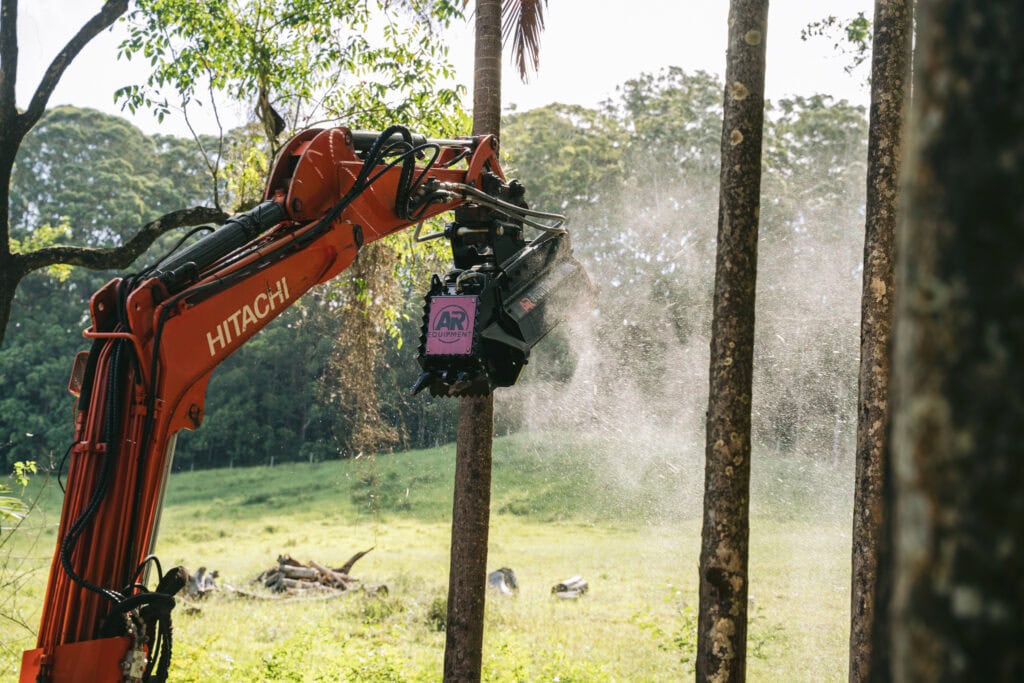
The heavy-hitter. An excavator forestry mulcher takes down standing timber, dense scrub, and woody vegetation up to around 350mm and processes it into mulch in a single pass. The mulch stays on site, breaks down over time, and feeds the soil rather than being carted away.
Forestry mulchers suit large-scale clearing projects, fire break creation, forest thinning, and any job where the volume of trees and vegetation is too much for lighter gear. They need a machine with the oil flow and pressure to drive them properly, which usually means 5 to 35 tonnes for excavator models. Skid steer versions exist for tighter sites.
The thing worth knowing about mulchers is that Australian timber is harder on them than European or North American softwoods, so the build of the motor and rotor matters. A bent-axis piston motor holds full torque under load, where cheaper swash plate designs back off when the work gets hard, and that’s the difference between productive days and constant downtime.
Flail Mowers
A step down in capability from a mulcher, and the right tool for a different job. An excavator flail mower handles dense grass, light scrub, blackberry, lantana, and regrowth up to roughly 80mm. It’s faster and cheaper to run than a mulcher and fits machines from 2 to 20 tonnes.
The fit is roadside vegetation, fenceline maintenance, property upkeep, and any clearing where the work is keeping vegetation down rather than tearing it out. A lot of contractors carry both a mulcher and a flail mower on the float because they cover different ends of the work.
Stick Rakes
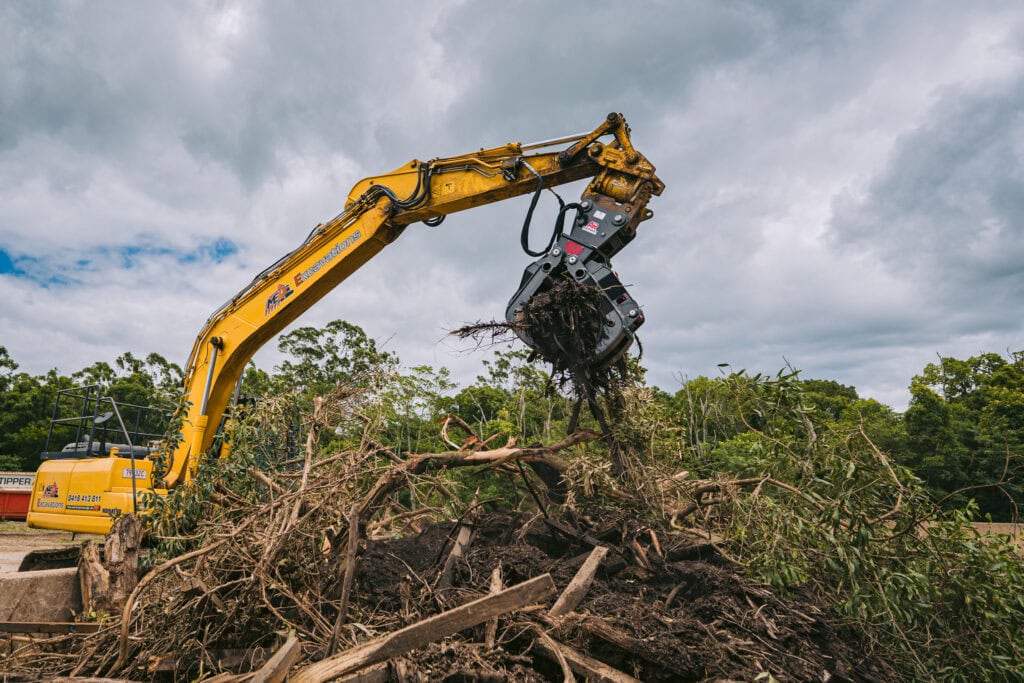
Once the scrub is down, the cleanup begins. An excavator stick rake handles root removal, windrowing felled timber, stacking debris for burning, and pulling stumps without carting half the topsoil off with them. Most operators running mulchers end up with a stick rake, too, because the two tools do different jobs well.
Rippers
When the work is below the surface, a ripper comes into its own. Compacted ground, stubborn root mass, hard soil that needs breaking up before clearing or follow-on construction. Straight-shank and multi-shank options cover different ground conditions and machine sizes.
Grabs
Once timber is on the ground, it has to be moved. Excavator grabs, including rotating and demolition variants, handle logs, brush piles, and cleared debris for loading, stacking, and positioning. Rotating grabs give the control needed in tight spots around retained trees, fences, or buildings.
Skid Steer Attachments
Not every job warrants a 20-tonne excavator. For smaller acreage, tight access sites, and ongoing property work, a skid steer mulcher or hi-torque slasher covers the same principle in a smaller package.
For a full look at the range, the land clearing equipment page covers what suits which weight class and conditions.
Safety on Land Clearing Sites
A land clearing site is a high-risk workplace. The basics that matter on any project:
- Exclusion zones around working machinery, sized to the gear in use and the material being processed (mulchers throw debris a long way).
- Falling hazards from dead timber, hung-up branches, and partially cut trees that haven’t dropped cleanly.
- PPE appropriate to the work, including hearing protection around mulchers, which run loudly.
- Underground services are identified before any ripping or stump removal begins. A Dial Before You Dig request is cheap insurance.
- Fire risk during dry months, especially anywhere mechanical work is generating heat or sparks. Total fire ban days shut clearing work down for good reason.
- Operator competency on the specific machine and attachment combination, not just the carrier.
Most serious incidents on clearing sites come back to assumptions, either about what’s around the machine, what’s in the ground, or what an attachment is capable of handling.
Environmental Considerations
Land clearing has environmental consequences, and the better operators plan around them during the development process rather than ignoring them.
Soil erosion is the immediate one. Stripping vegetation cover exposes topsoil, and on sloped or high-rainfall sites, a lot of it can move quickly. Temporary controls during the project and revegetation or ground cover after the work help limit the damage.
Biodiversity and habitat loss are the long-term issues. Native vegetation supports native species, and removing it has flow-on effects that don’t always show up immediately. This is why approvals exist for any land clearing project and why protected vegetation gets flagged at the assessment stage.
Where it makes sense, retaining mature trees, leaving habitat corridors, and mulching on site rather than burning all reduce the footprint of a clearing job. None of it is free, but it’s often a condition of approval anyway.
When to Get a Professional Involved
Small property work, like clearing a fenceline or knocking back grass, is realistic to handle yourself with the right gear. Anything involving standing timber, larger-scale, native vegetation, or steep ground is contractor territory.
Look for operators with experience in the type of clearing you need, the right machinery for the conditions, and a working understanding of the approvals in your state. A good contractor will walk the site before quoting and tell you straight if the job is bigger or smaller than you thought.
The Right Gear Makes the Job
Clearing land comes down to matching the right method and the right equipment to the site, the vegetation, and the end use. Whether the project is a development site, an agriculture paddock, or smaller areas of regrowth, getting that combination right means the work moves fast, the site ends up the way it needs to be, and the budget holds together.
At AR Equipment, we stock the largest range of land clearing attachments in Australia, with parts and service held locally. If you’re working out which attachments suit your machine and the job ahead, give the team a call on 1300 441 121 or get in touch through the site.
Frequently Asked Questions
It depends on the size of the site, the density of the vegetation, and the equipment running on it. A small residential block might take a day or two. Acreage clearing with heavy scrub can run weeks. The honest answer is that a proper site assessment gives a realistic timeframe, and anything quoted without one is guesswork.
In most cases, yes. Native vegetation clearing typically requires approval from the state environment department, and councils often have additional rules. Some bushfire hazard reduction work is exempt, but the rules are specific. Check with your state authority and council before starting.
Tree removal is taking down individual trees, usually with the trunk and root system handled in a controlled way. Land clearing is broader, covering all vegetation, stumps, roots, and debris across a site to make the area usable for another purpose.
For small jobs on your own property within the rules, owner-operator work is possible if you’ve got the right gear and experience. For anything involving large timber, native vegetation, steep ground, or commercial scale, a qualified contractor is the safer call. Operating a mulcher or ripper safely takes more than a quick read of the manual.
A forestry mulcher on a suitably sized excavator (5 tonnes and up) is the standard answer for dense scrub and standing timber. For grass and light regrowth, a flail mower is faster and cheaper to run. Most serious clearing jobs use a combination of both, plus a stick rake for cleanup.
It gets mulched on site, burned (subject to permits), stacked for later removal, or carted off to a green waste facility. Mulching on site is increasingly common because it keeps the organic matter on the block and avoids haulage costs.