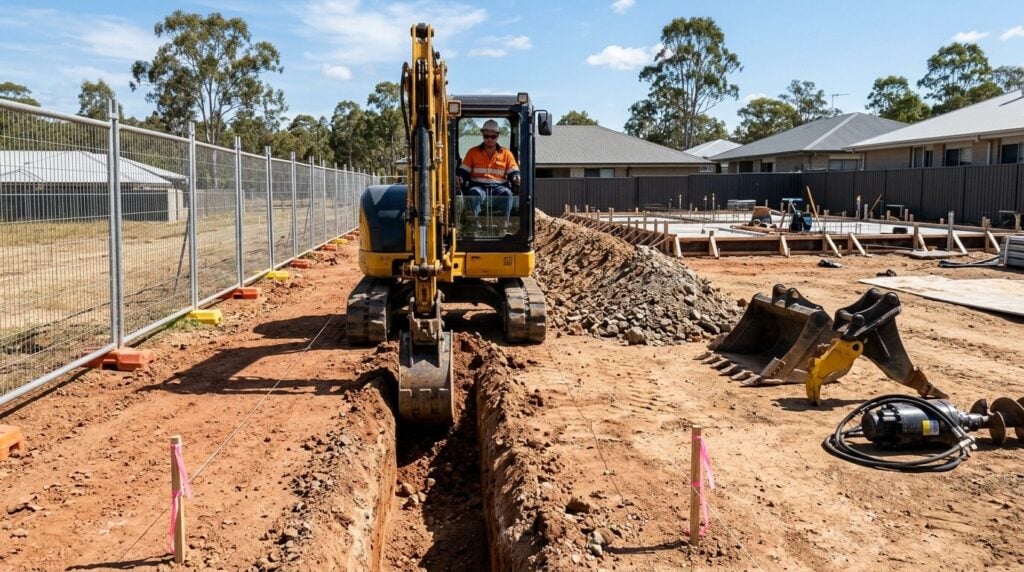
- Excavation in construction means removing soil or rock to form an open face, hole or cavity, such as a site cut, trench, footing or basement.
- An excavator works on almost every stage of a build, from clearing and the site cut through to trenching, backfill, compaction and demolition.
- The attachment does the real work. The right bucket, ripper, breaker, auger or grab can save days on a job.
- Match every attachment to your machine’s tonnage, hitch and hydraulic flow, and plan the dig around the excavation safety rules.
On a building site, the excavator is the machine that turns up first and leaves last. What it can get done comes down to what is on the end of the arm. A general purpose bucket will dig most things, but swap it for the right attachment and the same machine can rip rock, drill footings, compact a trench or pull down a slab.
This guide covers what excavation means in construction, what an excavator does at each stage of a build, and the attachments that do each job best.
What does excavation mean in construction?
Safe Work Australia’s model Code of Practice for excavation work defines excavation work as work involving the removal of soil or rock from a site to form an open face, hole or cavity using tools, machinery or explosives.
In building construction, that covers the site cut that levels a sloping block, bulk excavation for basements and car parks, trenches for footings, stormwater, sewer and services, holes for piers and pool shells, and the rock breaking that often comes with them. Most of it is done by excavator, because nothing else combines digging force, reach and the ability to swap tools on the same machine.
Types of excavation in building construction
Excavation is usually grouped two ways: by the material being dug and by the purpose of the dig.
By material:
- Topsoil. The top layer of soil and organic matter, stripped and stockpiled before the site cut so it can be reused for landscaping.
- Earth. The soil and clay below the topsoil, which makes up most of a bulk dig.
- Rock. Anything too hard for a bucket alone, which needs ripping, breaking or drilling.
- Muck. Wet, sloppy material with a high water content that has to be dried out or carted off before it can be used.
By purpose:
- Site cut and levelling. Cutting and filling to create a level building platform.
- Bulk excavation. Large-volume digs for basements, car parks and building pads.
- Trench excavation. Long, narrow digs for strip footings, drainage and underground services.
- Footing and pier excavation. Holes and short trenches for pad footings, piers and piles.
- Pool excavation. A shaped dig to a set depth and profile.
- Demolition and clearing. Removing existing structures, slabs and vegetation before the new work starts.
What an excavator does at each stage of a build
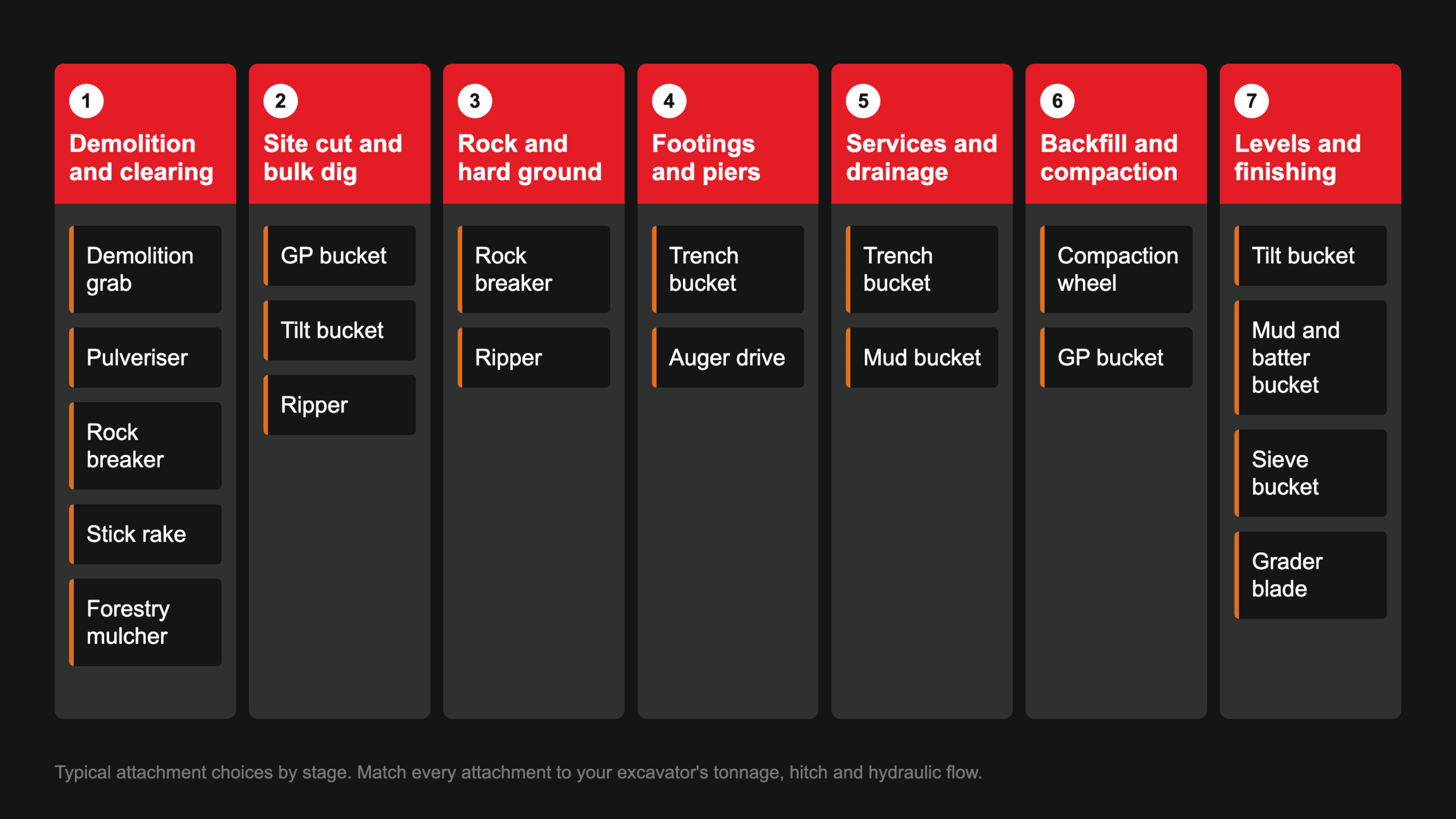
Here is how the work on a typical construction job lines up with the attachments that suit it.
| Stage | Typical work | Attachments that suit |
|---|---|---|
| Demolition and site clearing | Pulling down structures, breaking slabs, clearing scrub | Demolition grab, pulveriser, rock breaker, stick rake, forestry mulcher |
| Site cut and bulk excavation | Stripping topsoil, cut and fill, loading trucks | GP bucket, tilt bucket, ripper |
| Rock and hard ground | Breaking and loosening rock and hard clay | Rock breaker, ripper |
| Footings and piers | Strip footings, pad footings, pier holes | Trench bucket, auger drive |
| Services and drainage | Trenching for stormwater, sewer and services | Trench bucket, mud bucket |
| Backfill and compaction | Backfilling and compacting trenches and fill | Compaction wheel, GP bucket |
| Levels and finishing | Batters, swales, final levels, sorting material | Tilt bucket, mud and batter bucket, sieve bucket, grader blade |
The best excavator attachments for construction work
GP and trenching buckets
The general purpose bucket is the default for digging, loading and trenching in earth and clay. Narrower trench buckets cut cleaner, more accurate trenches for footings and services with less spoil to backfill. Our GP and trench buckets come in a range of widths to suit different trench sizes.
Mud, batter and tilt buckets
A mud or batter bucket is wider, with a straight cutting edge and no teeth, made for cleaning up, shaping batters and getting a smooth finish to final levels. A tilt bucket adds tilt each way, so the operator can cut batters, swales and drains to grade without constantly repositioning the machine. The tilt mud and batter bucket combines the two.
Rippers
When a bucket starts skating over hard clay, shale or weathered rock, a ripper concentrates the machine’s full breakout force into a single tooth. It loosens the ground so the bucket can dig it out, and is often faster and cheaper than breaking. See our excavator rippers.
Rock breakers
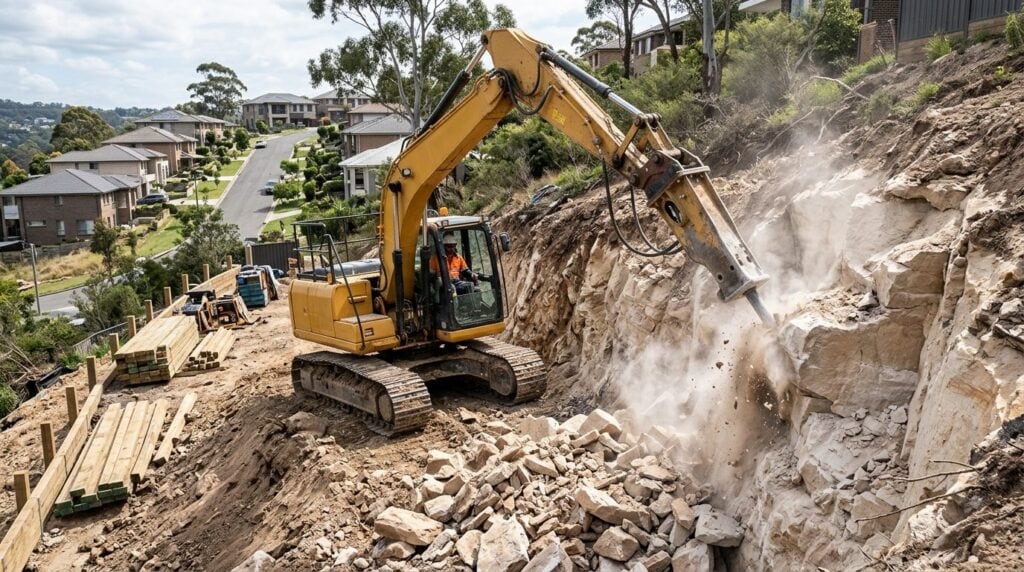
For solid rock and concrete, a hydraulic rock breaker is the answer. It is the go-to for site cuts that hit rock, pool digs, footing trenches in rock and breaking up old slabs during demolition. The excavation Code of Practice gives using an excavator with a rock breaker, rather than manual methods, as an example of a safer way to do the work.
Auger drives
An excavator auger drive drills clean, round holes for piers, pad footings, piles, retaining wall posts and fence posts far faster than digging them out with a bucket. Rock and earth auger bits are available to suit the ground conditions.
Grabs
Grabs pick up and place what a bucket cannot hold: logs, rocks, pipes, demolition waste and building rubble. A hydraulic grab for logs and rocks handles general site work, while a demolition grab is built for pulling apart and sorting structures. Our guide to excavator grab attachments covers the types in more detail.
Compaction wheels
A compaction wheel compacts backfill in trenches and around footings without putting anyone in the trench with a hand compactor. It uses the weight and down force of the excavator itself, so it works with no extra hydraulics.
Demolition attachments
For demolition before the build, a pulveriser or concrete crusher breaks reinforced concrete and separates the steel. Magnets pick up the steel for recycling.
Sieve buckets
A sieve or skeleton bucket separates rocks and debris from soil, so clean fill and topsoil can be reused on site instead of carted away.
For the full range, see our excavator attachments, or read our overview of the types of excavator attachments.
Match the attachment to your machine
The best attachment for the job is one your machine can actually run. Before you buy, check three things.
Tonnage class. Attachments are built for a set range of excavator weights. Too big and the machine is unstable and slow. Too small and you will break it. You can browse our range by machine size, from 1 to 2.5 tonne mini excavators through to 31 to 40 tonne machines.
Hitch. Check whether your machine runs a pin-on setup or a quick hitch, and the pin diameter and pin centres your attachments need to match. A double pin hitch or a tilting hitch can add flexibility across a fleet of attachments.
Hydraulic flow. Powered attachments like rock breakers, auger drives and mulchers run off the excavator’s auxiliary circuit. Each needs a set oil flow (in litres per minute) and pressure, and some need a case drain line. A mismatch means slow, weak performance or damage to the attachment or the machine. Your dealer or operator’s manual can confirm what your excavator delivers. Send us the make and model and we will match the attachment to it.
Excavation safety rules that shape the job
Picking the attachment is only part of planning the dig. These rules affect how and where the excavator works.
Find underground services first. Under the model WHS Regulations, the person managing the excavation must take all reasonable steps to get current information on underground services before work starts. Before You Dig Australia is free to lodge an enquiry, and asset owners may require hand digging or potholing near their services, because plans can be inaccurate.
Trenches deeper than 1.5 metres. Work in or near a trench with an excavated depth greater than 1.5 metres is high risk construction work and needs a Safe Work Method Statement. The sides of a trench at least 1.5 metres deep must be supported by shoring, benching or battering, and the trench secured from unauthorised access. Where there is a risk of engulfment, those controls should be used regardless of depth.
Keep spoil and plant back from the edge. The Code of Practice says excavated material, plant and vehicles should not sit within the zone of influence of an excavation, where their weight can trigger a collapse.
Use a safe quick hitch. An attachment that drops off a quick hitch can crush anyone working near the bucket. After a worker was injured this way, WorkSafe Victoria’s safety alert recommends replacing semi-automatic quick hitches with fully automatic ones, and checking that a safety system is fitted to stop an attachment releasing unexpectedly.
Operator competency. Operators must be able to show they are competent on the specific plant and any attachment fitted to it. Our guide to whether you need a licence to operate an excavator covers this in more detail.
The rules above are based on the model WHS laws. Check with your state regulator for the requirements that apply to your site.
Need help choosing the right attachments for your next construction job? Call our team on 1300 441 121 or request a quote with your excavator make and model.
Frequently asked questions
What does excavation mean in construction?
Excavation in construction means removing soil or rock from a site to form an open face, hole or cavity. It includes site cuts, bulk excavation, trenches, footings, pier holes, basements and pools.
What is an excavator used for in construction?
Excavators are used for demolition and site clearing, site cuts and bulk excavation, digging footings and service trenches, drilling pier holes, breaking rock, loading trucks, backfilling and compacting, and shaping final levels. Changing the attachment is what lets one machine do all of these.
What is the most useful excavator attachment for construction?
Most construction excavators work with a GP or trench bucket most of the time. After that, a tilt bucket, a ripper and a rock breaker see the most use, followed by an auger drive for footings and a compaction wheel for trenches.
What size excavator do I need for footings?
It depends on trench depth, ground conditions and site access. Small residential jobs are often done with mini and small excavators, while larger commercial footings and rock call for bigger machines. Choose the attachment to match the machine size you have.
Do I need to contact Before You Dig before excavating?
Yes. You need current information on underground services before excavating, and lodging a Before You Dig Australia enquiry is free. Asset owners may ask you to hand dig or pothole to confirm where their services are.
How deep can a trench be before it needs shoring?
Under the model WHS Regulations, the sides of a trench at least 1.5 metres deep must be supported by shoring, benching or battering. Where the ground is unstable or there is a risk of engulfment, those controls should be used at any depth.